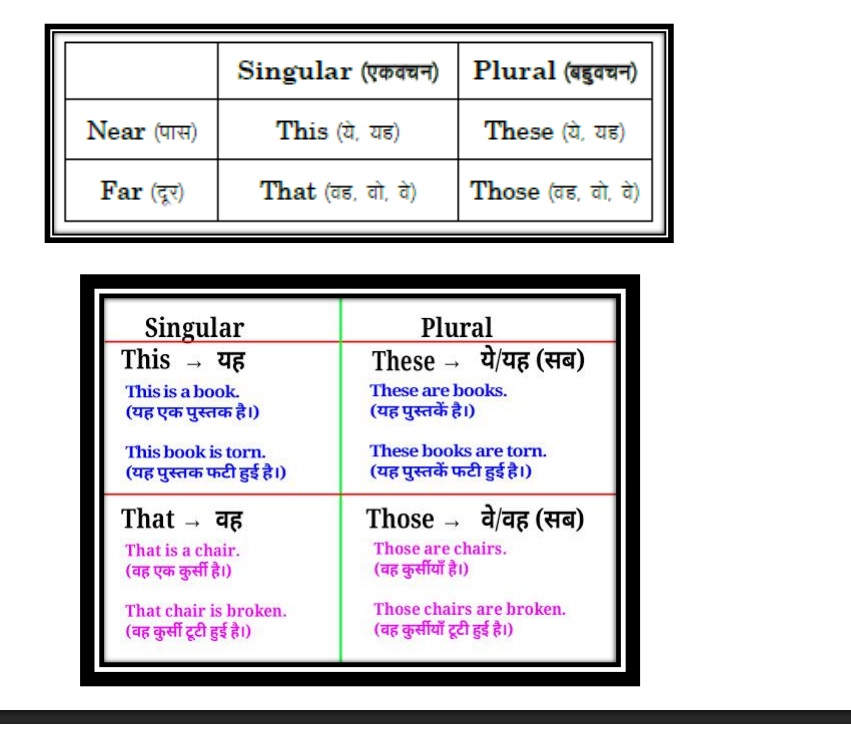
Use of This, That, These, Those
Meetings Greetings
Greeting someone depends on the age, relation and position of the person
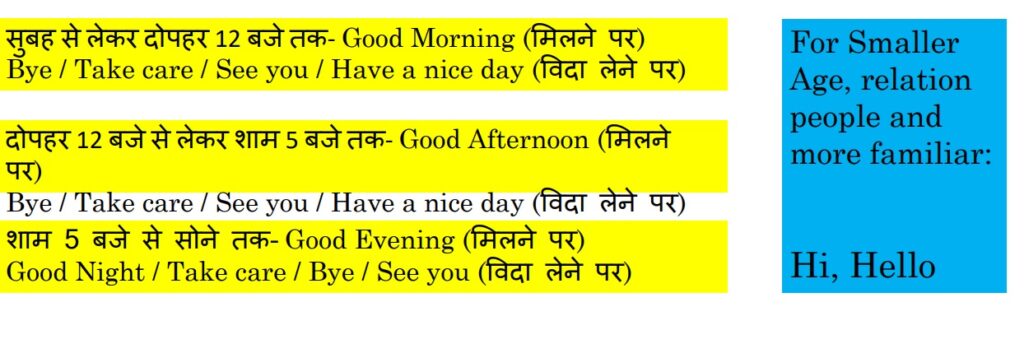
Good manners
How to greet people
- Good morning! How are you?
I’m fine, thanks. How are you?
- formal
- Hello! How are you doing?
Fine, just fine. How are you?
- informal
- Hi, how is it going?
Pretty good. How about you?
- informal
- Hi, what’s up?
Not much. What about you?
- informal
- What have you been up to?
The same as usual.
- informal
How to thank people
1. Thank you for looking after my son.
You’re very welcome.
2. Thanks for your help.
No problem.
3. Thank you for carrying my bag.
Don’t mention it.
4. That’s very kind of you but you really shouldn’t have gone to
all this trouble.
I was happy to help.
you shouldn’t have gone to all this trouble — a standard phrase
you say to someone who has done much work for you
How to say sorry
1. Sorry to have kept you waiting.
That’s ok.
2. Sorry I’m late.
No problem. I’ve only just got here myself.
3. I’m sorry about reading your messages.
Don’t let it happen again.
don’t let it happen again — a standard phrase you say to somebody
who has really upset you meaning “I hope you won’t do this again”
भाई और बहन के बीच बातचीत (Conversation between Brother and Sister)
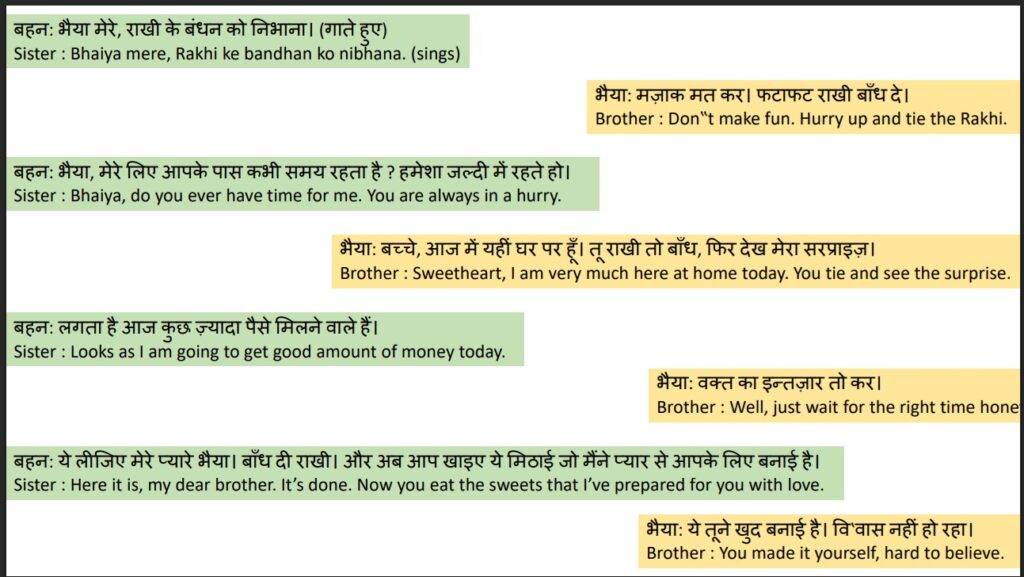
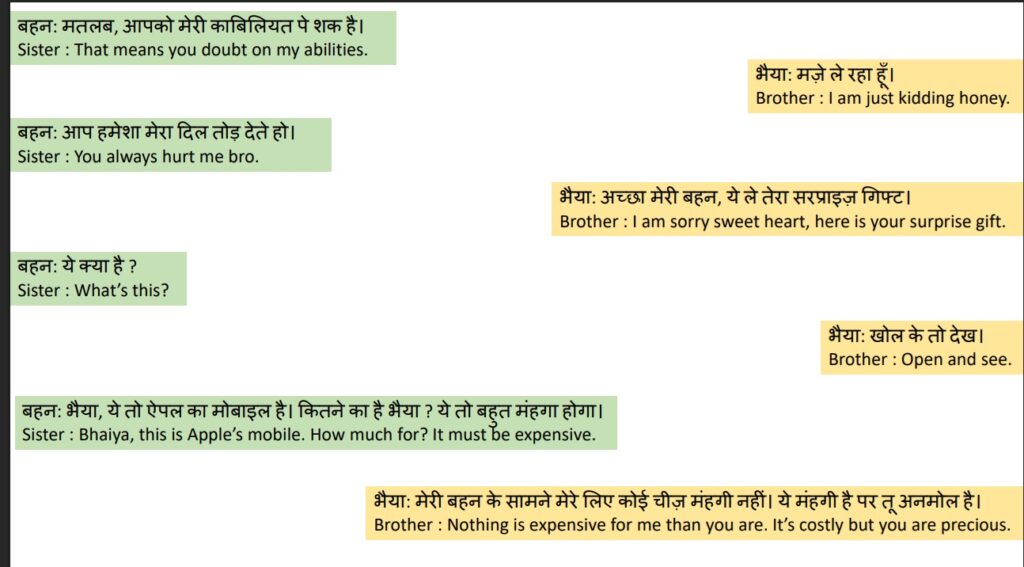
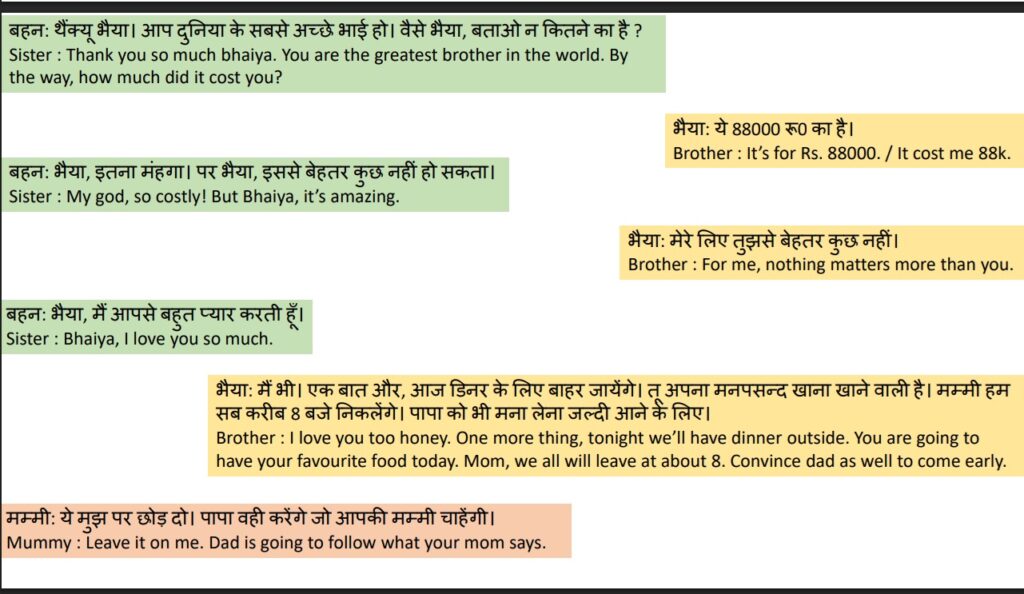
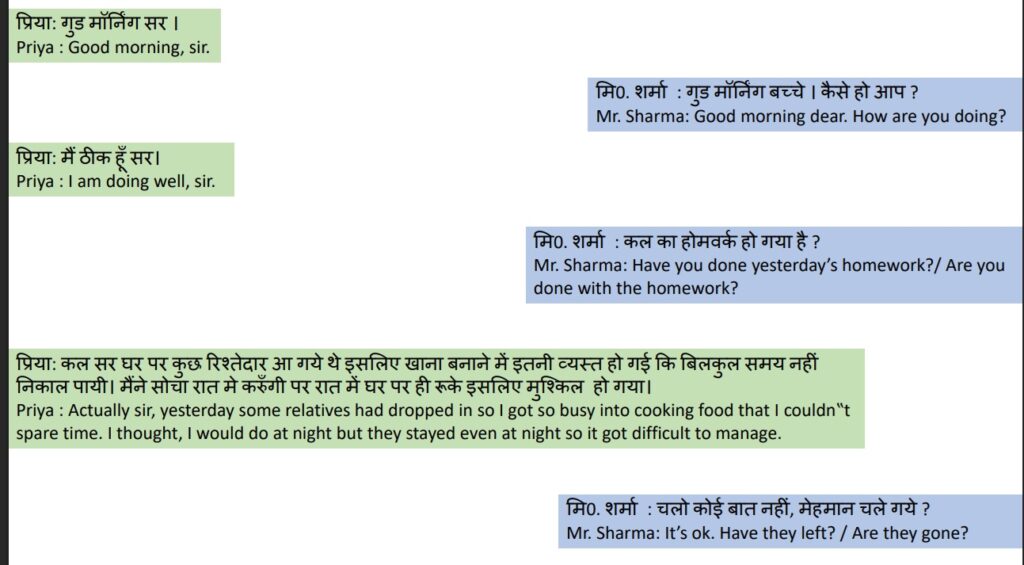
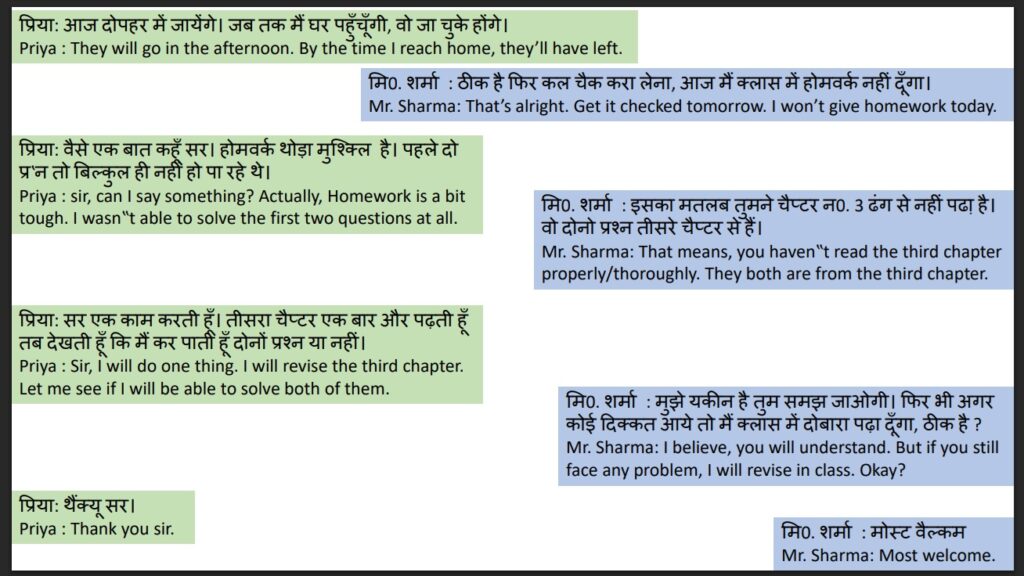
शिक्षक और छात्र के बीच बातचीत (Conversation between Teacher and Student)
How to ask people to do something for you
1. Could you open the window, please?
Sure.
2. Could you make me a cup of tea, please?
Yes, of course.
3. Could you give me his phone number, please?
I’m sorry but I don’t know his number.
4. Could you look after my son tonight?
I’m afraid I can’t. I’m working an evening shift today.
5. Do you mind moving your seat so that I and my friend could
sit together?
No, of course not.
(* positive answer)
6. Do you mind lending me some money?
I’m sorry, I’m broke.
(* negative answer)
shift work — the time period during which you are at work
to be broke — to have no money
How to offer people help
1. My flight arrives at 7 am.
Would you like me to meet you at the airport?
2. My car is broken, so I came to work by underground today.
Do you want me to give you a lift home?
3. The suitcase is so heavy.
Let me carry it for you!
4. What do these statistics mean?
Let me explain.
to give a lift — to take someone somewhere in your car
How to ask for permission to do something
1. Can I switch the TV on?
Sure, go ahead.
(* positive answer)
2. Can I read this e-mail?
No, I’m afraid not.
(* negative answer)
3. Do you mind if I sit here?
No, of course not.
(* positive answer)
4. Do you mind if I borrow your car tomorrow?
Yes, I’m afraid I do.
(* negative answer)
to borrow — to use another person’s thing and give it back later
How to suggest somebody an idea
1. It’s hot in here.
Let’s open the window.
Okay.
2. Let’s ask your mum to look after Johnny while we are away.
I’d rather not.
3. How about going there by train?
Sounds good!
4. How about painting the walls blue?
It doesn’t sound very good.
5. Why don’t we go to the beach?
Good idea!
6. Why don’t you get a new hairstyle?
I don’t feel like it.
How to agree and disagree with your companion
1. Kevin is musically gifted.
That’s true!
2. I think Martin Freeman is a brilliant actor!
Absolutely!
3. The facts, he gave us, are convincing.
I can’t see that!
4. He is an honest man.
I don’t think so!
gifted — talented
convincing — making you believe that something is true
How to give and accept a compliment
1. Your cake is really delicious!
I’m glad you like it!
2. You look gorgeous in this outfit. You have a great fashion
sense!
That’s very kind of you to say so.
3. Your presentation was great!
Thank you. I really needed that.
gorgeous — beautiful
an outfit — a set of clothes that you wear together
fashion sense — understanding what clothes look good
How to sympathize
1. Jill has had a heart attack! She’s just been taken to hospital!
How awful/terrible!
2. My back kills me!
I’m sorry to hear this!
3. I’ve lost one of my gloves.
What a shame!
4. I spent half an hour looking for my car key! It was so
frustrating!
I can imagine!
When I got to my car, I saw I had a flat tyre.
Oh, no!
frustrating — making you feel annoyed
a flat tyre — when there’s little air in the tyre
How to ask to repeat and check understanding
1. Are you following me?
No, you’ve lost me. Could you explain that again, please?
2. Are you with me?
Sorry, what was that again?
3. Am I making sense?
Could you explain that another way/just one more time, please?
to make sense — to be easy to understand
How to finish a conversation and say good-bye
1. It was nice to talk to you but I’ve got to go now.
You too. See you around.
2. It was great to see you, but I must dash now.
It was good to see you too. Take care.
3. I should get going.
Ok. See you later.
4. I’m running terribly late!
Ok. See you around.
5. I hope we meet again soon.
Yes, let’s keep in touch.
to dash — to go quickly because you’re in a hurry
to keep in touch — to write or call each other from time to time
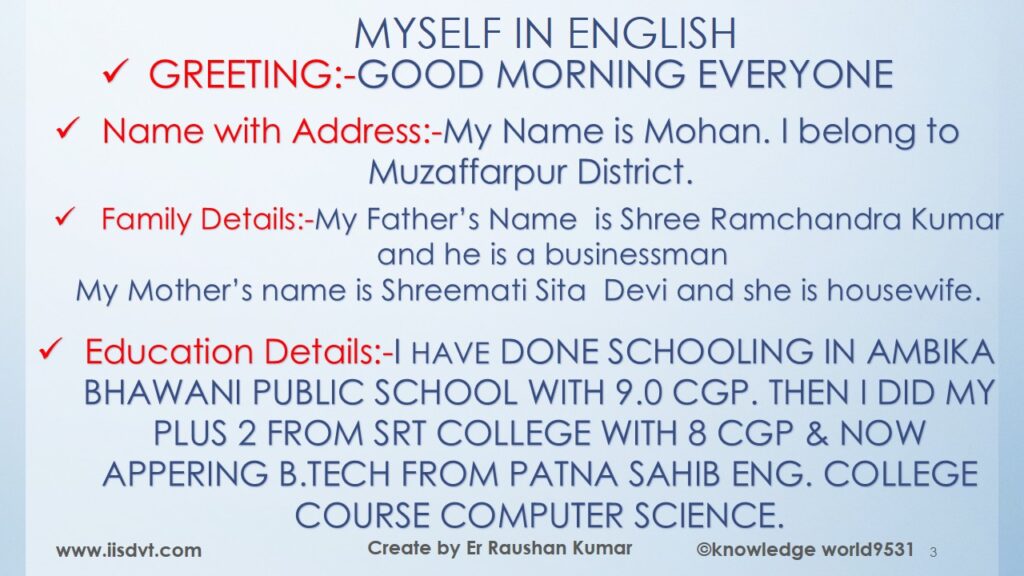
How to introduce yourself
1. Great party, isn’t it?
Yeah. It’s cool.
I’m Ruth.
I’m Julia. Nice to meet you.
You too.
2. Hi, I’m Kevin.
Hi, Kevin! I’m David. Nice to meet you.
You too, David. So, how do you know the host? (at a party)
I and Daniel work together. What about you?
I live next door.
a host — a person who invites guests to his/her home
next door — a house next to yours
How to introduce people
1. Laura, meet Seon! Seon, this is Laura!
Nice to meet you, Seon.
You too, Laura!
2. James, this is Chris. Chris, this is James.
Nice to meet you, James!
You too, Chris. I’ve heard a lot about you!
All good, I hope.
How to welcome a new employee
1. Hi, I’m Claire.
Nice to meet you. I’m Robert.
You too. Are you new here?
Yes, it’s my first day here.
2. You must be Susan.
Yes, right.
I’m Jill. Nice to meet you, Susan. Let me show you around.
Nice to meet you too, Jill. Thank you.
3. Hello, Jake. Welcome to the Nesco Company. Let me
introduce you to some people.
Thank you, that would be nice.
4. Hi, I’m Jeff. Are you new here?
Yes, I’m Alex. I’m a new paralegal.
Where will you be working?
On the seventh floor.
We’ll be seeing a lot of each other then.
to show you around — to show you a place (an office or home)
to introduce — to tell someone another person’s name when they
see each other for the first time
a paralegal — someone who has legal training and helps a lawyer
Нow to make an invitation
1. Would you like to come to my birthday party?
I’d love to! What time is your party?
5 pm.
I’ll be there. Thanks!
2. Would you like to come over for dinner tonight?
That would be lovely but I’ve got a previous arrangement.
What a shame!
I would love to come another time!
3. I’d love it if you could come to stay but do you mind dogs?
No, of course not. Thank you for inviting me.
a previous arrangement — a plan you had made before you were
invited
How to welcome guests
1. Hi, come in!
Hi! Nice to see you!
I’m glad you could make it.
Thank you for asking me.
2. Hi, come in.
Nice to see you! You look wonderful!
Thank you! It’s a pleasure to have you here.
I’m very glad I came.
3. Nice to have you here.
I’m glad I could come.
How was your journey?
I hit a traffic jam but quite smooth after all.
to make it — to manage to get somewhere
to hit a traffic jam — to drive up the road that is busy with other
drivers
smooth — without problems
How to compliment your host on their home
1. You’ve got a lovely house.
Thank you. Let me show you around.
2. Come into the living room and have a seat.
Your living-room is very beautiful!
3. Make yourself comfortable.
Thank you!
How to offer guests a drink
1. Would you like a drink?
Yes, please. What have you got?
2. Can I get you something to drink?
Yes, please. I’d like a cup of tea.
3. How do you take your coffee?
Two sugars, no milk, please.
How to offer food to your guests
1. Help yourself to the cookies.
Thank you! They are delicious.
2. Please, go ahead with the salad, I’ll bring the lamb in red wine
in a minute.
Sounds delicious!
3. Can I get anyone anything?
No, thanks. We are full. The meal was delicious.
4. Are you done?
Yes, thank you. It was delicious.
help yourself — used to offer food and drink
delicious — tasty
to go ahead — to continue to do something
Are you done? — Have you finished with you meal?
How to thank your host for hospitality
1. Thank you for having us.
We are glad you could come. I hope you have a safe journey.
2. Thank you for inviting us. We had a great time.
Come back again. It was good to see you.
How to ask somebody out on a date
1. What are you up to today?
Nothing really. Why?
Would you like to go to the cinema tonight?
Yeah, what’s on?
2. I was thinking… Do you want to meet up for a drink some
time?
Sounds good!
What about tomorrow evening?
I am busy this week maybe next week some time?
3. I was wondering if you would have dinner with me?
Dinner? Why not? When?
How about tonight?
Sorry, I can’t make it tonight.
Can you make it tomorrow then?
Yes, tomorrow is fine.
I can’t make it tonight — I can not meet you tonight
How to refuse a date
1. Would you like to go out some time?
That’s nice of you, but I’m already seeing someone.
2. What are you doing this weekend?
I am going to my parents’ place. Why?
I just thought we could grab a coffee sometime.
No, sorry. You’re a nice guy, but I’m just not into you in that way.
to see someone — to be in a romantic relationship with someone
to be into someone — to be interested in someone
How to ask a stranger out on a date
1. I’ve just moved here. Are there any good cafés in the area?
There’s a good Chinese place near here.
Would you like to join me for dinner there sometime?
I’m not sure. I don’t even know you.
Right, but you seem like a really nice person and I want to get to
know you better.
2. I just saw you and I think you look really nice.
Thank you.
What are you doing right now?
Just taking a walk.
Then why don’t we have a coffee over here.
3. I want to tell you that you look very pretty and I want to get to
know you.
Thank you.
Can you give me your number so I can call you sometime?
Okay.
4. I enjoyed talking to you and would like to get to know you
better. If you feel the same, here’s my number.
I’ll call you.
to get to know — to know somebody better
How to make small talk
1. Nice day, isn’t it.
Yeah, it’s lovely outside.
2. It looks like it’s going to snow.
I hear they are calling for snow all weekend.
3. I can’t believe how quiet this place is today.
Strange, isn’t it? It’s usually packed on Fridays.
4. Can you believe all this rain we’ve been having?
Yes, we sure have!
5. I love your outfit! May I ask where you got it?
Thank you. I got it at Zara.
6. Getting excited about your trip?
Yeah, I’m really looking forward to it.
to call for snow — to say that it will snow
packed — having a lot of people
excited — very happy
to look forward to — to feel happy about something that is going to
happen
How to avoid answering a question
1. How much do you earn?
I’d rather not say.
2. I’ve heard you’ve split up with Christy.
If it’s okay with you, I’m not really up to talking about it.
How to make an appointment
1. Can we meet on the 16th of July?
Yes, it’s fine with me.
2. Can you make it on Friday morning?
Yes, it suits me perfectly.
3. Are you available on Thursday evening?
I’m afraid I can’t make it on Thursday evening. What about a bit
earlier on Thursday? Say, 3 pm?
4. What about Saturday?
I’m afraid I can’t on Saturday. Can we meet on Sunday instead?
to make it on Friday — to be available on Friday
How to change an appointment
1. We were going to meet on Friday but something has come up.
Can we fix another time?
Sure. Would Monday be ok?
2. I’m afraid, I won’t be able to meet you after all. Can we make
another time later in the week?
Ok. What time is best for you?
to come up — if a problem comes up, you need to deal with it
immediately
How to ask if a shop sells an item you need
1. Hello! Have you got souvenir mugs?
Yes, we have them here.
2. Have you got umbrellas?
Yes. I’ll show you. Are you looking for men’s or ladies’ umbrellas?
A ladies’ one.
How to buy things
1. Can I have this calendar, please?
Here you are/There you go.
2. How much is it?
It’s 10 pounds.
3. Can I have a carton of milk and a loaf of bread, please?
Here you are/There you go. That’s 4 euros.
4. Can I have a box of tissues, please?
I’m sorry, we are out of tissues.
5. I’m looking for a dishwasher.
Freestanding or built-in?
6. I’m looking for a pair of shoes to go with this dress.
How about these ones?
7. I’d like to buy a gift card, please?
How much do you want to put on it?
8. I’d like a new SIM card for my phone.
What’s your phone model?
9. Can I help you?
No, I am just looking around.
Just let me know if you need anything.
here you are/there you go — said when you give something to
someone
we are out of tissues — we have no more tissues in stock
How to book a flight
1. What flights are there to Oslo?
There are two flights tomorrow. One is at 7.30 am and the other one
is at 4 pm.
2. Are there any direct flights to Dallas?
No, you’ll have to transfer either in Chicago or Kansas City.
3. I’d like to book a flight to Beijing, please.
What date will you be travelling?
The 19th of March.
There is a flight at 5. 20 am. Would you like to be booked on it?
Yes, please.
to transfer — to change a plane
How to change a flight reservation
1. I’d like to change my flight reservation.
Ok. What’s your booking number?
2. What would you like to change?
I’d like to take an earlier flight if possible.
3. I’m booked on flight number XPL on April 12. Can I change
this to a later date, please?
What date would you like to depart?
4. Will I have to pay a change fee?
Yes, because you booked a flight over 24 hours ago.
a fee — money you pay for service
How to check-in
1. Can I see your passport and tickets, please?
Here you are.
I’m afraid, your flight has been delayed. It’s now scheduled to
depart at 4.30 pm.
2. Would you like an aisle or a window seat?
A window seat, please.
to be delayed — to be later than planned
to be scheduled — to be planned at a particular time
to depart — to leave
an aisle seat — a seat near the passage between rows
How to rent a car
1. I’d like to rent a car.
For how long?
For 3 days.
2. What type of car would you like?
I’d like a midsize car. How much would it cost?
30 dollars per day.
3. Would you like insurance on your car?
Yes, please.
How many people are going to drive?
Just myself.
4. Can I see your driver’s licence?
Will my international licence do?
5. Do I have to return a car to this location?
No, you can leave it at any of our locations. Remember to return it by
2 am on Wednesday.
How much would you charge me if I’m an hour late?
an insurance — an agreement in which you pay a company money
and they pay your costs if you have an accident.
to charge — to ask to pay money
How to rent a flat
1. I’m calling about the flat for rent. Is it still available?
Yes, it is.
Can I see it today?
2. How much is the rent?
It’s 1200 dollars per month.
Are the utilities included?
No, you’ll have to pay them yourself.
3. When is the rent due?
On the first of each month. It’s paid in advance.
4. Will the rent go up?
Not until the end of the lease. When your lease expires the rent may
go up.
5. How much is the security deposit?
It’s a month’s rent.
6. Can I sublet?
Yes, you can but you must get written permission from us first.
7. How much notice do I need to give if I want to leave early?
You need to give a month’s notice.
8. Who do I contact if there is a problem?
Me. Here is my phone number.
9. When will the flat be available?
Next month.
We need to think about it. Can we call you tonight?
Sure.
the rent is due — must be paid
in advance — before a particular time
a (rental) lease — a rental contract
to expire — to come to end
a security deposit — money you pay when you start to rent a flat
and which is given back to you when you stop renting it
utilities — gas, water, electricity
to sublet — to rent out the flat or part of the flat that you are renting
permission — when you allow somebody to do something
to give notice — to inform someone of something
How to ask for a bill
1. Can I have the bill, please?
Coming right up.
2. We’d like separate bills, please.
Sure.
How to say that the bill is incorrect
1. I’m afraid there is a mistake in the bill. I didn’t order the
milkshake.
I’m sorry. I’ll bring you the correct bill right away.
2. I’m afraid there is a mistake in the bill. You charged me twice
for the dessert.
I’m sorry, Mam. I’ll bring you the correct bill right away
How to talk about problems with equipment
1. The washing machine isn’t working.
Do you know what’s wrong with it?
2. The remote control isn’t working.
The batteries might have run out.
3. Is the printer broken?
No, it’s not. It’s just has run out of paper. Let me refill it for you.
4. My lock is broken. The key doesn’t turn.
You should call the locksmith.
a remote control — a thing you use to switch on and off TV from a
short distance away
to run out — to finish
to refill — to put something into a container again
a lock — a part of a door you put your key in to open or close it
a locksmith — a person who fixes locks
How to talk about household appliance problems
1. The kettle doesn’t seem to be working.
It could be the cable. Is it plugged in properly?
2. The tap in the kitchen is dripping.
I’ll send the plumber in right now.
3. One of my burners won’t light.
It can be clogged. Just clean it.
4. The bulb is blown.
I’ll replace it right now.
a kettle — a container you use for boiling water
to plug in — to connect a piece of equipment to an electricity supply
a tap — a thing in the bathroom or kitchen where water comes out of
to drip — when water falls in small drops
a burner — a part of a cooker that you heat pans on
to be clogged — to become blocked so that nothing can go through
it
a bulb — an object in a lamp that gives light
How to report an emergency
1. There is a robbery in progress in the neighbour’s home.
What’s the address?
2. There is a fight in progress outside the bar.
Hold on. I’ll get the police dispatched.
3. There’s a car accident.
Is anyone hurt?
The driver of one of the cars.
4. There’s a car accident.
How many cars/people are involved?
Two cars.
Is anybody trapped inside the cars?
One man is.
The ambulance is on the way.
What should we do until they arrive?
5. We are stuck in the lift/elevator.
Do you know the address where you are at?
Yes, it’s…
The rescue team will be there in 15 minutes.
6. My house is on fire.
The fire crew is on its way.
7. My house is flooding.
Have you got a burst pipe?
8. Someone is breaking into my house.
I already have the police coming.
a robbery — stealing something using force
dispatched — sent
a crew — a group of people working together
to flood — to become covered with water
to burst — to break because there is too much air inside
a pipe — a tube that carries water
to break into a house — to get into somebody’s house illegally
How to report a crime at the police station
1. I’d like to report a crime.
Can you tell me what happened?
My bag has been stolen.
2. I’ve been attacked.
When and where did it happen?
3. I’d like to report a break-in.
Was anything stolen?
a break-in — when someone illegally gets into your house or your
car
How to give a reason for your call
Can I speak to someone from the HR department?
Can I ask what’s it in connection with?
I’m calling about applying for the job of a sales representative.
I’ll connect you to the person in charge of it.
to remind — to make somebody remember something
to suggest — to give someone an idea to think about
to apply for — to officially ask for a job
to be in charge of — to have control over somethin
Hi, Brian. How are you doing?
Fine. And you?
I’m good. What can I do for you?
I’m calling to remind you of our dinner plans.
Hi, Rita! What can I do for you?
You suggested I call you to discuss a few ideas. I am calling to let you
know I’m interested.